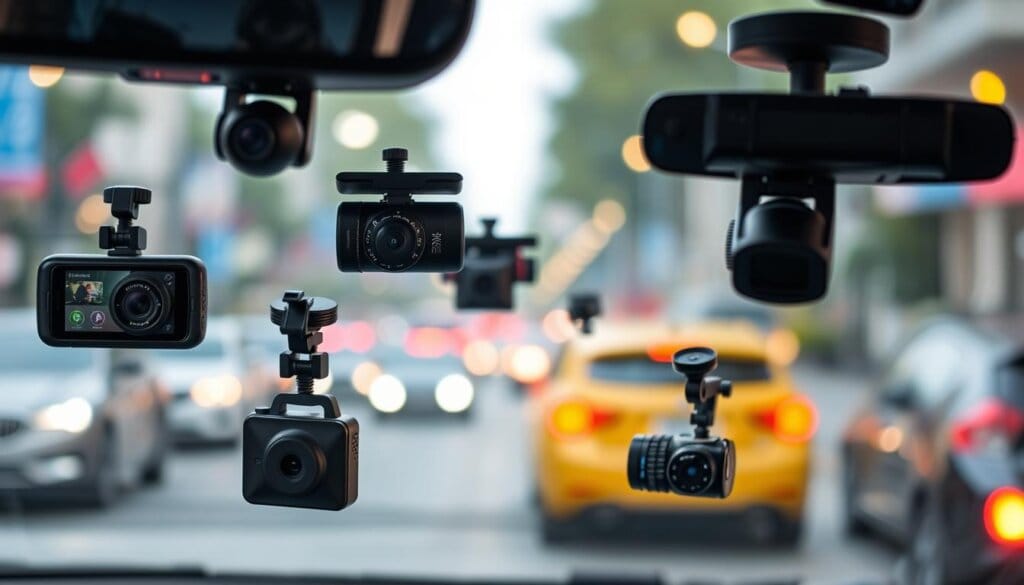
This guide serves as the Domain Pillar for DashCameraGear.com. It provides the technical framework necessary to evaluate automotive recording hardware against three primary use cases: Personal Memories, Legal Protection, and Professional Vlogging.
Selecting the “best” camera requires moving beyond Amazon star ratings and evaluating raw sensor performance, thermal reliability, and encoder bitrates. Use this master source to establish your baseline requirements before diving into specific budget or vehicle-type guides.
The Three Recording Archetypes: Why Are You Recording?
Every dash cam user falls into one of three functional categories. Your category determines which hardware specifications (EAV attributes) matter most.
The Memory Maker (Road Trips & Scenery)
Focuses on optical fidelity and color accuracy to preserve scenic drives and family vacations.
- Priority Specs: 4K resolution (3840×2160), high dynamic range (HDR), and CPL filters to remove windshield glare.
- Reference Hardware: Viofo A229 Pro or Rexing V1P (4K variant).
The Risk Manager (Insurance & Legal Protection)
Focuses on textual legibility (license plates) and environmental reliability.
- Priority Specs: Sony STARVIS 2 sensors, GPS coordinate logging, and G-sensors with high-priority event locking.
- Reference Hardware: Viofo A119 Mini 2 or Vantrue E1 Lite.
The Professional Vlogger (Content Creation)
Focuses on multi-channel synchronization and cabin audio quality.
- Priority Specs: Interior/Cabin lenses with infrared (IR) night vision, 3-channel recording, and 5GHz Wi-Fi for rapid file offload.
- Reference Hardware: Vantrue N4 or Viofo A139 Pro.
Master Technical Benchmarks: The Expert Baseline
To ensure your hardware meets the “Evidence-Grade” standard, we have established the following Lab Benchmarks. Any camera falling below these thresholds is classified as recreational rather than professional protection.
| Attribute (EAV) | Minimum Requirement | Expert Benchmark | Purpose |
|---|---|---|---|
| Target Bitrate | 15 Mbps (1080p) | 30 – 45 Mbps (4K) | Prevents alphanumeric blur during high-speed closure. |
| Boot-to-Record Time | < 12 Seconds | < 5 Seconds | Ensures coverage starts before the vehicle clears the driveway. |
| Thermal Range | 0°C to 50°C (32°F – 122°F) | -20°C to 70°C (-4°F – 158°F) | Prevents hardware failure/fire in high-heat dashboards. |
| Sensor Technology | Standard CMOS | Sony STARVIS 2 (BSI) | Enables usable night evidence in 0.1 lux conditions. |
| SoC / Chipset | Legacy / Entry-level SoCs | Novatek 9-series (e.g. NT96529) | High-velocity encoding for 4K/HDR multi-channel streams. |
| Power System | Lithium-Ion Battery | Supercapacitor | Ensures safe file-saving during catastrophic impact. |
Strategic Navigation: Finding Your Specific Guide
Once you have established your technical requirements using the benchmarks above, use the following routing nodes to find the specific bestseller list for your vehicle or budget:
Budget-Specific Guides
- Entry-Level: Best Dash Cameras Under $50 (Basic Protection).
- Evidence-Grade: Best Dash Cameras Under $100 (Starvis 1/2 Entry).
- Premium Performance: Best Dash Cameras Under $200 (4K and Dual Channel).
Vehicle-Specific & Specialized Systems
- Professional Trucking: Long-Trailer Wireless & Multi-Channel Systems.
- Motorcycle Touring: Weather-Tested Rugged Systems.
- RV & Motorhome: Wireless Backup & Wide-Angle Solutions.
Conclusion: From Knowledge to Evidence
Selecting a dash cam is no longer about “getting a camera”—it is about building a reliable evidence chain. By adhering to the Domain Pillar Benchmarks of 30+ Mbps bitrates and STARVIS 2 sensors, you ensure that your investment performs when it matters most.
For a deeper dive into specific components, consult our Dash Camera Basic Feature Guide or learn How to Properly Install and Hardwire Your System for 24/7 parking protection.
Frequently Asked Questions About Choosing the Best Dash Cam
How do I choose the best dash cam for my vehicle?
To choose the best dash cam, first identify your primary goal: legal protection, road trip memories, or rideshare security. For most drivers, we recommend a dual-channel system (front and rear) with at least 1080p resolution and a supercapacitor power supply for long-term reliability in varying climates.
What should I look for when buying a dash cam in 2026?
In 2026, the critical technical attributes to look for include Sony STARVIS 2 sensors for superior night vision, H.265 (HEVC) encoding for efficient storage, and high bitrate support (30+ Mbps) to ensure license plates remain legible at highway speeds. Always prioritize supercapacitor-powered models over battery-based units to avoid thermal failure.
Which is the best dash cam for overall safety and evidence?
The best dash cam for safety is one that offers synchronized multi-channel recording and a high-accuracy G-sensor. This ensures that even in a side-impact or rear-end collision, the footage is automatically locked and preserved on a high-endurance microSD card. Look for models with voice alerts that confirm the system is actively recording.
Is there a single “best” dash cam on the market right now?
While “best” is subjective, the current market leaders for 2026 are models featuring the Novatek 9-series SoC paired with 4K resolution. These systems provide the highest optical density and processing speed, making them the most reliable choice for capturing identifiable evidence in complex traffic scenarios.
Are recommended dash cams different for trucks and cars?
Yes. Recommended dash cams for trucks require specialized features like wireless rear transmission (for long trailers) and multi-channel (3-4 lens) capabilities to cover blind spots. Standard passenger cars can usually rely on wired dual-lens systems that are easier to install and more discreet.
