Maximizing DFOV Trajectory Capture for Blind Spot Mitigation
Wide Angle Dash Camera Features
Catch Every Detail, Big and Small, and Avoid Blind Spots
A wide angle dash camera has revolutionized how semi-truck drivers and commercial fleet operators navigate the roads. Choosing the best wide angle dash cam for truckers can mean the difference between capturing decisive evidence and missing critical details in a collision or dispute.
With an expansive field of view (FOV), these devices offer truckers an unparalleled perspective of their surroundings, enhancing road safety and situational awareness. Industry experience and testing show that a broad FOV—typically 140° to 180° or more—directly improves evidence quality for insurance claims and fleet safety programs.
The benefits of a broad field of view for truck drivers range from improved visibility and blind-spot coverage to better evidence collection in the event of an incident. This guide covers the key features and functions of wide angle dash cameras for semi trucks, including lens specs, panoramic recording, and what to look for when buying a wide-angle dash cam for commercial vehicles.
Importance of Field of View
The field of view in dash cameras for commercial vehicles is critical in determining how much of the road and its surroundings are captured. A wide angle lens can significantly maximize the coverage area, ensuring that events occurring directly ahead and to the truck’s sides are recorded. This comprehensive road visibility is vital for truckers, who must be aware of multiple lanes and adjacent areas due to the size of their vehicles. A wide-angle dash camera acts as an extra set of eyes, providing a complete picture of traffic conditions, potential hazards, and unexpected events. For long-haul and regional drivers, FOV in degrees (e.g., 170° vs 120°) directly affects how much lane width and shoulder area appears in the footage—making it a key attribute when comparing models.
Feature Summary:
Feature | Function | Benefits |
|---|---|---|
| Wide Angle Dash Camera | Optimal viewing angle, clarity, range of field of view | Enhances safety and monitoring for truck drivers |
| Lens Quality | Impacts clarity and field of view | Integral to the performance of the wide-angle dash camera |
| Night Vision Capability | Allows for clear recording in low light conditions | Improves the functionality of the dash cam for truckers during nighttime |
| Distortion Correction | Reduces image distortion in wide-angle lenses | Enhances the accuracy of the recorded footage |
| Panoramic Recording | It provides a more extensive view of the surroundings | Expands the coverage area beyond traditional dash cams |
| Multi-Camera Dash Cam Systems | Offers multiple viewing angles and coverage | Provides comprehensive monitoring around the truck |
| Adjustable Mount Trucker Dash Cam | Allows for flexibility in camera positioning | Enables truckers to customize the field of view based on their specific needs |
| Dash Cam Field of View Range | Varies among models, affects the amount of road captured | Directly influences the effectiveness of the dash cam for truckers |
| FOV Adjustment | Ability to change the field of view | Provides versatility in different driving scenarios |
| Real-Time Viewing Dash Cams | Enables live monitoring of camera feed | Offers immediate situational awareness for truckers |
Wide Viewing Angle Features
Dash cams with 180-degree coverage offer an almost panoramic view of the road and are among the best options for semi-truck and fleet use. These wide viewing angle features are essential for capturing as much detail as possible. For 2026, the Sony STARVIS 2 sensor is the benchmark for wide-angle clarity, as it suppresses the peripheral motion blur often found in cheaper ultra-wide lenses. Safety is also a key benefit: the extended view helps truckers monitor adjacent lanes and blind spots, reducing the risk of sideswipe and lane-change collisions. High-performance chipsets encode these ultra-wide 4K streams at 30-45 Mbps high-bitrate, ensuring that license plates at the edge of the frame remain legible. The wide angle lens, combined with a quality image sensor and HDR, ensures that even at high speeds or in mixed lighting, the camera can record a stable and clear image—essential for the fast-paced environment of truck driving.
Panoramic Recording Capabilities
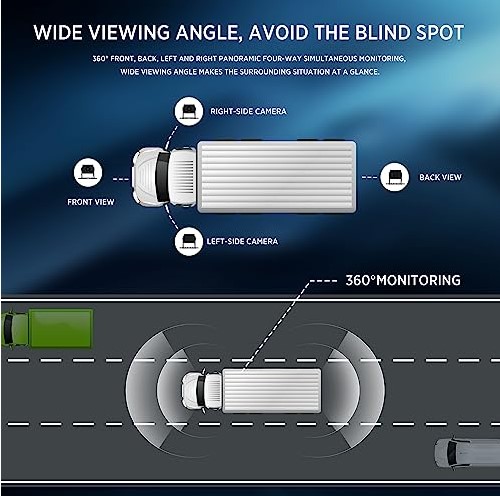
Panoramic recording capabilities in dash cameras are designed to minimize blind spots by providing a full horizon capture. This function is especially valuable for semi trucks, which have larger blind spots than passenger vehicles. By offering a continuous view of the road, panoramic dash cams help truckers stay aware of their surroundings, making it easier to navigate tight spaces, change lanes, and reverse safely. Some dash cameras use multiple lenses that stitch together footage for a seamless panoramic view, ensuring that no critical detail goes unnoticed. For fleet managers, choosing a model with true panoramic or ultra-wide FOV can improve driver accountability and incident review quality.
Multi-Lens Support and Compatibility
Adding extra camera lenses can expand the viewing angles further, offering truckers a comprehensive surveillance system. Multi-lens dash cams may include rear and side cameras, providing a 360-degree view of the truck. This compatibility with additional lenses is invaluable for truckers who need to monitor their vehicle’s entire perimeter, especially when maneuvering in crowded areas, docking at loading bays, or backing in yards. Dual- and triple-channel wide angle dash cam setups are increasingly common in commercial trucking for full coverage and defensible evidence.
Adjustable Camera Angles for Customized Views
Dash cams with swivel or ball-mount designs allow truckers to adjust the camera angle to their preference, offering a customized view. This flexibility is crucial for drivers who must focus on specific areas depending on their route or driving conditions—for example, emphasizing the right-hand side in countries where that’s the primary passing lane. Adjustable camera angles also let truckers reposition the camera to avoid obstructions like sun glare or reflections, ensuring the footage remains clear and usable for insurance or compliance.
Night Vision Enhancements
Infrared LED enhancements and high-sensitivity sensors for low-light recording are a game-changer for truckers who often drive at night. Superior night vision capabilities in wide angle dash cameras ensure that the footage remains sharp and discernible even without adequate street lighting. This feature is essential for capturing clear images of license plates, road signs, and other critical details necessary for post-incident analysis. When comparing models, look for attributes such as “night vision,” “WDR,” and “HDR” to get the best wide angle dash cam for truckers in low-light conditions.
Split Screen Display for Multi-Angle Monitoring
Dash cams with split-screen display features allow truckers to monitor multiple angles simultaneously on a single screen. This is particularly useful when using multi-lens systems, as it provides a comprehensive view of the truck’s surroundings without switching between different camera feeds. Real-time monitoring can be crucial in preventing accidents and ensuring the safety of the cargo and other road users. It also supports faster driver reaction when something appears in a secondary view (e.g., rear or cabin).
Fisheye Lens Correction Technology
While wide angle lenses offer extensive coverage, they can introduce distortion (e.g., curved lines at the edges). Fisheye lens correction technology minimizes this distortion, ensuring that the recorded images are as authentic to life as possible. Dash cams with this feature automatically adjust the curvature caused by the wide angle lens, providing a more accurate representation of the road and its surroundings—which improves readability of signs and plates and the credibility of footage in disputes.
High-Resolution Recording for Clarity
The relationship between resolution and image clarity is well established. High-resolution wide angle dash cams (e.g., 1080p full HD or 4K) capture footage with greater detail, which can be crucial when identifying vehicle models, license plate numbers, or facial features. For semi-truck drivers, a high-resolution wide-angle dash camera is an indispensable tool for documenting journeys with clarity and precision and for meeting the evidence standards that insurers and legal teams expect.
Advanced Features for Driver Assistance
Modern wide angle dash cameras often include driver assistance features that enhance safety and compliance. Lane departure warnings alert truckers if they begin to drift out of their lane; forward collision alerts provide a timely warning to help prevent accidents. GPS integration tracks the vehicle’s location and supports fleet management, route optimization, and hours-of-service context. These advanced features contribute to a safer driving experience and help truckers maintain efficiency and compliance with driving regulations. When selecting a wide angle truck dash cam, consider whether you need ADAS (advanced driver assistance) and GPS for your operation.
Frequently Asked Questions
We’ve explored the benefits and features of wide-angle dash cameras for the trucking community. Below are answers to common questions to help you choose and use a wide angle dash camera for truckers.
1. What is the importance of a wide field of view in a dash camera for truckers?
A wide field of view in a dash camera for truckers is essential because it captures a broader area of the road and surroundings. Large vehicles like semi trucks must monitor multiple lanes and adjacent areas, reducing blind spots and increasing safety.
2. How does a 180-degree coverage dash cam benefit semi-truck drivers?
A 180-degree coverage dash cam benefits semi-truck drivers by offering an almost panoramic view, which is essential for capturing as much detail as possible, aiding in insurance claims and traffic disputes, and enhancing safety by monitoring adjacent lanes and blind spots.
3. What are panoramic recording capabilities, and how do they assist truckers?
Panoramic recording capabilities are designed to capture a whole horizon, minimize blind spots, and help truckers by offering a continuous road view. This is particularly useful for navigating tight spaces and changing lanes confidently.
4. Can you expand the viewing angles of a dash cam with additional lenses?
Yes, you can expand the viewing angles of a dash cam with additional lenses. Multi-lens support includes rear and side cameras, providing a 360-degree view around the truck, which is invaluable for truckers needing to monitor their vehicle’s entire perimeter.
5. What is the advantage of adjusting camera angles on a dash cam?
The advantage of adjusting camera angles on a dash cam is the flexibility it offers drivers to focus on specific areas depending on their route or driving conditions and to reposition the camera to avoid obstructions like sun glare, ensuring clear footage.
6. Why is night vision capability important in a dash cam for long-haul drivers?
Night vision capability is vital in a dash cam for long-haul drivers. It ensures that footage remains sharp and discernible even in low-light conditions, capturing clear images of critical details necessary for post-incident analysis.
7. How does a split screen display enhance the use of a multi-lens dash cam system?
A split screen display enhances a multi-lens dash cam system by allowing drivers to monitor multiple angles simultaneously on a single screen, providing a comprehensive view of the truck’s surroundings without switching between camera feeds.
8. What is fisheye lens correction technology, and why is it important?
Fisheye lens correction technology is crucial because it minimizes the distortion typically introduced by wide angle lenses, ensuring that the recorded images are as accurate as possible, which is crucial for a true representation of the road and its surroundings.
9. How does high-resolution recording improve the functionality of a broad field-of-view dash camera?
High-resolution recording enhances the functionality of a wide field-of-view dash camera by capturing greater detail, which is essential for identifying features such as vehicle models, license plate numbers, or facial features, especially for commercial vehicle drivers.
10. What advanced features should truckers look for in a wide angle truck dash cam?
Truckers should look for advanced features in a wide-angle truck dash cam, such as lane departure warnings, forward collision alerts, and GPS integration. These features contribute to a safer driving experience.
We value your feedback and encourage you to explore our site for more information about dash cameras. Keep in mind that incident recording reliability depends heavily on specific hardware specs; we suggest reviewing our dash cam guide for beginners to understand core features—like STARVIS 2 sensors and high-bitrate encoding—that turn simple clips into reliable legal evidence.
We value your feedback and encourage you to explore our site for more information about dash cameras.
Conclusion
Wide angle dash cameras are an essential investment for semi-truck drivers, offering a range of features that enhance road safety, visibility, and overall driving experience. From panoramic recording capabilities to advanced driver assistance features, these devices provide truckers with the tools to navigate the roads confidently and securely. The value of a high-quality wide angle dash camera is clear: it is not just a piece of technology but a vital partner in ensuring the safety of truckers and the goods they transport.